In 2026, manufacturers are operating under a combination of pressures that makes static electricity more expensive than it has ever been. Line speeds are higher, defect tolerances are tighter, automation density is greater, and customer audit standards have become more demanding. At the same time, rework labor costs have risen, material costs have increased, and the margin available to absorb preventable quality losses has shrunk.
Static electricity sits at the intersection of all of these pressures. It is not a safety issue in isolation — it is a production cost driver that shows up in paint nibs and orange peel defects on coated surfaces, in print ghosting and misregistration on packaging lines, in film handling jams that stop automated equipment, and in latent ESD failures in electronics that pass inspection and fail in the field. Every one of these outcomes has a measurable cost: scrap material, rework labor, cleaning downtime, and the customer complaint rate that affects repeat business.
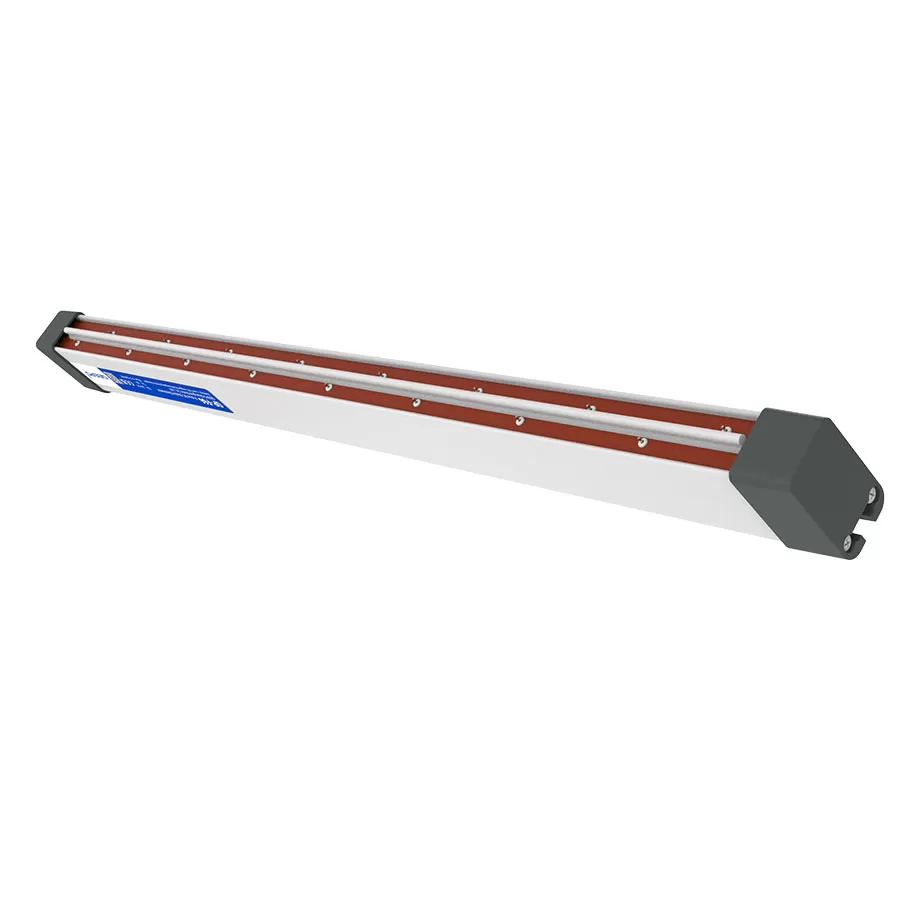
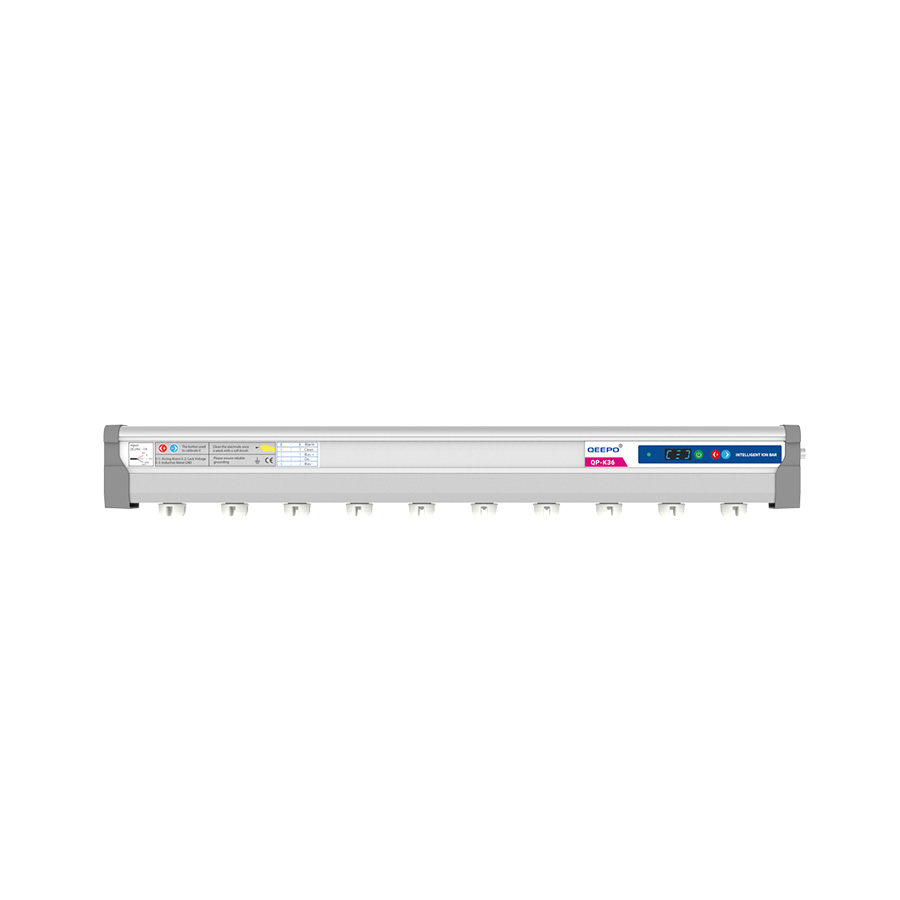
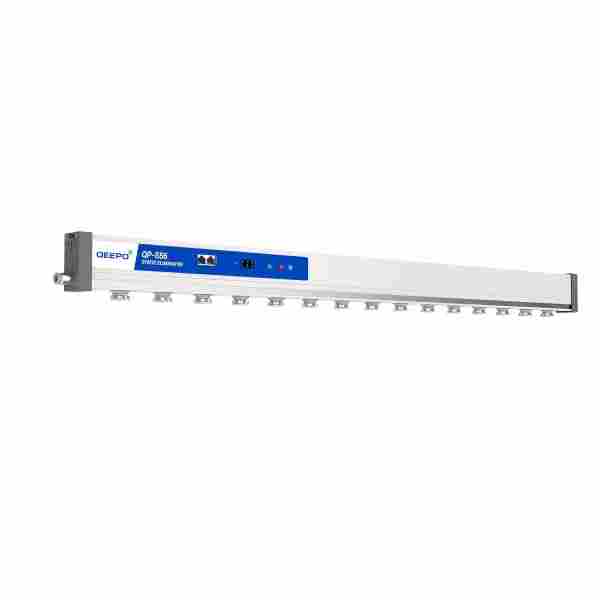
A well-matched static eliminator — sourced from experienced static eliminator manufacturers with application-specific product formats — converts static control from a compliance checkbox into a measurable ROI investment. QEEPO's static eliminator lineup covers the full range of industrial static control requirements: ionizing bars for close-range point neutralization, intelligent models with sensor feedback for high-precision processes, room and space static elimination for cleanrooms and dust-free workshops, and explosion-proof options for hazardous area compliance.
Understanding the working principle of a static eliminator clarifies why it addresses the root cause of dust attraction and handling problems — not just the symptom.
A static eliminator uses a high-voltage power generator to apply a high-voltage signal to a discharge electrode — typically a tungsten needle or array of needles along a bar. The high electric field at the electrode tip ionizes the surrounding air molecules through corona discharge, creating a continuous supply of positive and negative ions in the air adjacent to the electrode.
When these ions reach a charged surface — carried by the natural airflow around the electrode, by a directed compressed air stream, or by a fan — the ions of opposite polarity to the surface charge are attracted to the surface and neutralize it. The result is a surface that is at or near zero charge, which no longer attracts airborne dust particles and no longer generates the discharge events that cause ESD damage.
The business case for static elimination is built on two mechanisms. First, a neutralized surface does not attract airborne particles — which means the dust that would otherwise adhere to a freshly painted surface, a printed substrate, or an electronic component during handling is not attracted and does not cause a defect. Second, a neutralized film or sheet does not stick to adjacent surfaces or to machine components — which means the handling jams, misfeeds, and wraps that stop automated equipment and require operator intervention do not occur.
Both mechanisms reduce cost directly: fewer dust-caused defects reduce scrap and rework, and fewer handling jams reduce downtime and the labor cost of clearing and restarting the line.
Selecting a static eliminator based on the correct performance specifications — rather than on price alone — is the decision that determines whether the system delivers the scrap and downtime reduction that justifies the investment.
Static removal speed — the time required to neutralize a surface charged to a defined test voltage — determines whether the static eliminator can keep pace with the line speed. A system that requires 2 seconds to neutralize a surface is not effective on a line where the product passes the neutralization zone in 0.3 seconds.
QEEPO's bar models achieve static removal speeds as fast as ≤0.1 seconds on applicable models, supporting high-speed printing, coating, and film handling lines where the product dwell time in the neutralization zone is short. Confirm the required neutralization time for the specific line speed and neutralization zone length before selecting a model.
Ion balance describes the ratio of positive to negative ions in the output. A well-balanced static eliminator neutralizes charged surfaces without adding charge of the opposite polarity — which is the "re-charging" failure mode that occurs when a poorly balanced system replaces one charge problem with another.
The QP-S56 static eliminator specifies ion balance at approximately ±30V with stable long-term performance. The QP-S35 intelligent static eliminator specifies ion balance at ≤±30V with sensor-linked feedback that allows the system to monitor and maintain balance over time — the most important feature for high-precision processes where ion balance drift causes gradual quality degradation that is difficult to diagnose without monitoring.
| Power Architecture | Models | Integration Implication |
|---|---|---|
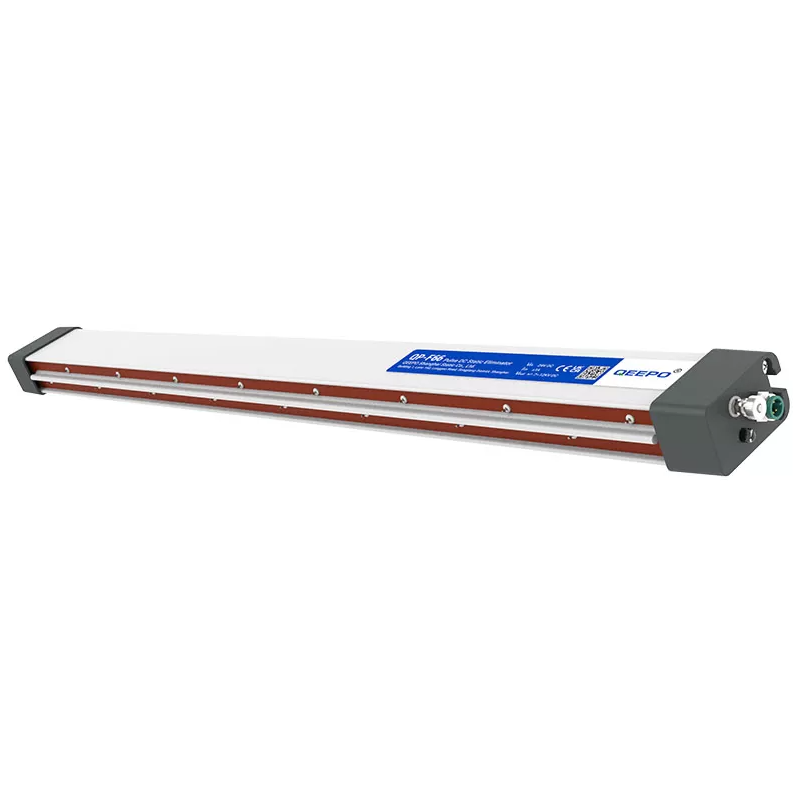
| 24V DC input | QP-F66 pulsed DC static eliminator | Direct integration with machine control systems; no separate HV power supply required |
| Dedicated HV power supply | QP-H35 with QP-HD series | Separate power supply unit required; supports longer bar lengths and higher output |
| Compressed air assisted | QP-ES-I Air source static eliminator | Requires compressed air supply; delivers ions at longer distances without fan airflow |
For production environments where flammable solvents, dusts, or gases are present — painting booths, solvent-based coating lines, and certain chemical processing applications — standard static eliminators cannot be used without explosion-proof certification. The QP-F35A explosion-proof static eliminator carries the Ex sc IIB T4 Gc marking and uses a compressed-air ion delivery design that eliminates the electrical components from the hazardous zone. This is not an optional upgrade for hazardous area applications — it is a compliance requirement.
For cleanrooms and dust-free workshops where the static control requirement is area-wide neutralization rather than point neutralization at a specific process step, the QP-F66(SSE) room static eliminator provides space-level ion distribution with series connection capability and status reminder functions. This format is appropriate when the entire work area needs to be maintained at a low static level — for example, in a cleanroom where operators handle ESD-sensitive components at multiple stations across the room.
The business case for static elimination is strongest when the static problem is causing a measurable, recurring cost — not when it is causing an occasional nuisance. The following application scenarios represent the highest-ROI use cases for industrial static control.
In painting and coating operations, static charge on the substrate surface attracts airborne dust particles before and during the coating application. The dust particles become embedded in the coating layer, producing surface defects — nibs, craters, and orange peel texture — that require sanding, polishing, or complete rework to correct. In automotive and appliance coating operations, a 1% reduction in dust-caused defect rate on a high-volume line can represent hundreds of thousands of dollars per year in avoided rework cost.
Installing a static eliminator at the substrate cleaning and pre-treatment stage — before the coating is applied — neutralizes the surface charge that attracts dust, reducing the particle contamination rate before the coating is applied. The result is a measurable reduction in surface defect rate and a corresponding reduction in rework and scrap cost.
In printing operations, static charge on the substrate causes dust attraction that produces print ghosting, misregistration, and ink adhesion problems. In packaging operations, static charge on film and sheet materials causes sticking, misfeeds, and wraps around rollers and guides that stop the line and require manual clearing.
QEEPO's static eliminator range is positioned specifically for improving printing quality and preventing material jams — the two most common static-caused production problems in printing and packaging environments. Installing static eliminators at the unwind, print, and rewind stations neutralizes the charge that accumulates as the film moves through the machine, reducing both the print quality problems and the handling instability that cause downtime.
In electronics assembly, static charge causes two distinct quality problems. ESD discharge events during component handling can damage gate oxides and create latent failures that pass electrical test but fail in the field — the most expensive type of defect because the failure cost is borne by the customer rather than the manufacturer. Dust attraction to PCB surfaces and component leads causes contamination that affects soldering quality and long-term reliability.
Both problems are addressed by static elimination at the handling and assembly stages. The QP-S35 intelligent static eliminator's sensor feedback capability is particularly relevant for electronics applications, where ion balance drift can cause the system to add charge rather than remove it — a failure mode that is difficult to detect without monitoring and that can cause more ESD damage than no static control at all.
| Application | Recommended Format | Key Selection Criteria |
|---|---|---|
| High-speed printing or film handling | Bar model with fast decay (≤0.1s) | Line speed, neutralization zone length, mounting distance |
| High-precision electronics or critical coating | Intelligent model with sensor feedback (QP-S35) | Ion balance monitoring, alarm output, integration with line control |
| Cleanroom or dust-free workshop | Room static eliminator (QP-F66(SSE)) | Room dimensions, series connection requirement, status monitoring |
| Hazardous area (solvent coating, chemical processing) | Explosion-proof model (QP-F35A) | Ex certification requirement, compressed air availability, zone classification |
| Medium to long-distance neutralization | Pulsed DC model (QP-F66) | Distance to target surface, available power (24V DC), coverage length |
Before finalizing the static eliminator selection, confirm the following integration parameters:
Available power supply — 24V DC for direct machine integration or a dedicated HV power supply for bar systems that require it. The power architecture affects both the installation complexity and the flexibility to integrate the static eliminator's status output with the machine's control system.
Mounting space and distance to target surface — the neutralization effectiveness of a static eliminator bar decreases with distance from the target surface. Confirm that the mounting position allows the bar to be installed within the effective range for the selected model, and that the mounting structure does not interfere with the product path or the maintenance access to the electrode.
Compressed air availability — only required for compressed-air assisted models such as the QP-F35A explosion-proof unit. Confirm the available air pressure and flow rate at the installation point before specifying a compressed-air model.
Safe cable routing — high-voltage cables from the power supply to the bar must be routed away from operator access zones and away from other electrical cables that could be affected by the high-voltage field.
The primary maintenance requirement for a static eliminator is electrode cleaning. Dust, oil mist, and process residues accumulate on the discharge electrode needles over time, reducing the corona discharge intensity and degrading the ion output. An electrode that is not cleaned regularly produces progressively worse neutralization performance — which means the static-caused defect rate gradually increases back toward the pre-installation baseline without any obvious indication that the system has degraded.
Establish a cleaning schedule based on the contamination rate in the specific production environment. In clean, low-contamination environments, monthly cleaning may be sufficient. In painting booths, coating lines, or environments with significant airborne contamination, weekly or even daily cleaning may be required to maintain performance.
The QP-S35 intelligent static eliminator includes real-time display and monitoring features that provide visible status feedback on the system's operating condition. For critical applications where ion balance drift or electrode degradation could cause quality problems, the monitoring capability reduces the "silent failure" risk — the condition where the static eliminator appears to be operating but is no longer providing effective neutralization because the electrode has degraded or the ion balance has drifted.
Integrate the status output of intelligent models with the line's alarm system where possible, so that electrode degradation or power supply faults trigger an operator alert rather than being discovered during a quality audit.
| Cost Item | Without Static Eliminator | With Correctly Specified Static Eliminator |
|---|---|---|
| Dust-caused defect scrap rate | Baseline — determined by static charge level and airborne particle concentration | Reduced — neutralized surfaces do not attract particles |
| Handling jam frequency | Baseline — determined by static charge on film and sheet materials | Reduced — neutralized materials do not stick to machine components |
| Cleaning stop frequency | High — dust accumulation on product and tooling requires frequent cleaning | Lower — less dust attraction reduces cleaning frequency |
| Rework labor cost | High — dust defects require sanding, polishing, or recoating | Lower — fewer defects reduce rework labor requirement |
| Customer complaint rate | Higher — latent defects and surface quality issues generate field complaints | Lower — consistent surface quality reduces complaint rate |
| Audit compliance risk | Higher — static-caused defect variability creates audit findings | Lower — documented static control supports quality system compliance |
For a coating line producing 10,000 units per month with a 3% dust-caused defect rate and a unit rework cost of $8, the monthly rework cost from dust defects is $2,400. A static eliminator system that reduces the dust defect rate from 3% to 0.5% avoids $2,000 per month in rework cost. Against a system cost of $6,000 to $8,000 for a correctly specified bar and power supply installation, the payback period is 3 to 4 months — before accounting for the downtime reduction from fewer handling jams and cleaning stops.
The payback period is shorter for higher-volume lines, higher unit costs, or higher defect rates. It is longer for lower-volume lines or applications where the static problem is causing latent failures rather than visible defects — because the cost of latent failures is harder to quantify until a field failure event occurs.
A static eliminator system is one of the few production upgrades that improves quality and productivity simultaneously — because the root cause it addresses, static charge, drives both surface defects and handling instability at the same time. When the cost of dust-caused scrap, handling jams, and cleaning downtime is quantified, most production lines find that a correctly specified static elimination system pays back within 3 to 6 months, making it one of the highest-ROI investments available in a 2026 manufacturing environment where material costs are high and defect tolerance is low.
The key is selecting the correct format — bar, intelligent, room, or explosion-proof — and installing it at the point in the process where static is causing the measurable cost, not at a generic location that does not address the actual defect mechanism.
Visit the static eliminator product page to review the full range, then submit the following details to receive a matched solution and quotation:
| Parameter | What to Provide |
|---|---|
| Work condition | Industry and process (printing, painting, electronics, plastics), cleanroom class if applicable, hazardous area requirement (yes or no) |
| Quantity | Number of lines or stations, shifts per day |
| Size and spec | Neutralization distance, coverage length and width, mounting constraints, available power (24V DC or external HV supply), compressed air availability if needed |
| Target metrics | Scrap reduction target, allowable decay time and ion balance targets, uptime and OEE goal |
| Current problem | Dust defects, print ghosting, film sticking or jams, ESD failures, frequent cleaning stops |
1. What is a static eliminator?
A static eliminator is a device that removes static electricity from material surfaces by generating positive and negative ions through high-voltage corona discharge and delivering those ions to the charged surface. When the ions reach the surface, they neutralize the static charge — positive ions neutralize negatively charged surfaces and negative ions neutralize positively charged surfaces — leaving the surface at or near zero charge. A neutralized surface does not attract airborne dust particles and does not generate the discharge events that cause ESD damage to electronic components. Static eliminators are available in multiple formats — bars, intelligent models with sensor feedback, room units for area-wide neutralization, and explosion-proof models for hazardous environments — to match the specific geometry and process requirements of different production applications.
2. How does a static eliminator compare to an ionizing air blower and grounded brushes?
A static eliminator bar or emitter provides direct ion output for targeted neutralization at a specific point on the production line — the correct choice when the static problem occurs at a defined location and the product passes close to the neutralization zone. An ionizing air blower adds fan airflow to carry ions over a wider area, which is useful when the coverage requirement is larger than a bar can address or when the product is at a distance from the ionizer — but the airflow may be unacceptable in applications where it could disturb lightweight components or contaminate open product surfaces. Grounded brushes and conductive contacts can dissipate charge from conductive materials that are in physical contact with the grounding element, but they cannot address non-contact charging of insulating materials — which is the most common static problem in film, plastic, and coated substrate handling. For most industrial static control applications involving insulating materials at production line speeds, a static eliminator bar or intelligent model is the most effective solution.
3. How do I calculate the ROI and payback period for a static eliminator?
The payback calculation requires three cost inputs: the monthly scrap cost from static-caused defects (units per month multiplied by the defect rate attributable to static multiplied by the unit rework or scrap cost), the monthly downtime cost from static-caused handling jams and cleaning stops (downtime hours per month multiplied by the line cost per hour including labor and overhead), and the monthly maintenance labor cost for cleaning and rework activities that static elimination would reduce. The sum of these three monthly costs is the monthly saving that the static eliminator system will deliver. Dividing the system cost — including the static eliminator, power supply, mounting hardware, and installation labor — by the monthly saving gives the payback period in months. For lines where dust defects and handling jams are measurable and recurring, payback periods of 3 to 6 months are common for correctly specified systems.
4. Do we need to modify the production line to install a static eliminator?
In most cases, only light modifications are required: mounting brackets to position the bar at the correct distance from the product surface, power routing for the 24V DC supply or the HV power supply unit, and safe cable routing away from operator access zones. For bar systems that use a dedicated HV power supply, the power supply unit requires a mounting location near the bar and a power connection to the machine's electrical panel. For compressed-air assisted models such as the QP-F35A explosion-proof unit, a compressed air connection at the installation point is required. For hazardous area installations, the installation must be reviewed against the site's area classification and the explosion-proof model's certification scope before installation proceeds. In all cases, the most important installation step is confirming that the bar is positioned within the effective neutralization range for the selected model and that the coverage zone matches the width of the product or substrate being neutralized.
5. What parameters should we provide to static eliminator manufacturers for correct selection?
Provide the material type being processed (film, plastic sheet, paper, PCB, coated substrate, or other), the line speed in meters per minute, the distance from the mounting position to the target surface, the coverage length required along the product width, the production environment classification (standard, cleanroom, or hazardous area), the available power supply (24V DC or AC for HV power supply), whether compressed air is available at the installation point, and the specific defect symptom being addressed — whether that is dust nibs on a coated surface, print ghosting or misregistration, film sticking or misfeeds, ESD failures in electronics assembly, or frequent cleaning stops from dust accumulation. Material type and distance to target surface are the two parameters that most directly determine which static eliminator format and model is correct for the application.

 +86-17717352246
  andy@qeepo.cn
 English
  日本語
日本語  한국어
한국어  français
  Español
  русский
  português
  العربية
  tiếng việt
  ไทย
ไทย  Polska