In my years of helping factories optimize their assembly lines with QEEPO, I’ve often seen engineers struggle with a confusing problem: they have anti-static mats and grounding straps everywhere, yet their sensitive components are still failing QC tests.
The culprit is usually "insulative static"—charge stuck on plastics, tapes, or glass that grounding wires simply cannot touch. That’s exactly where the ionizer fan (also known as an ionizing blower) becomes the hero of the workspace. Today, I’m going to break down why this tool is a non-negotiable part of any serious ESD-safe environment.
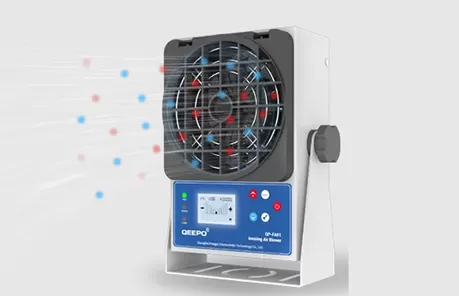
The primary purpose of a QEEPO ionizer fan is to neutralize static charges on non-conductive materials.Standard grounding methods only work for conductive or dissipative materials. If a plastic housing or a piece of adhesive tape becomes charged, that energy stays "trapped." An ionizer fan solves this by flooding the air with a balanced mix of positive and negative ions.When these ions hit a charged surface, the laws of physics take over: the surface attracts the opposite charge from the air and automatically returns to a neutral state (0 Volts). Without this, your components are sitting ducks for a sudden Electrostatic Discharge (ESD) event.
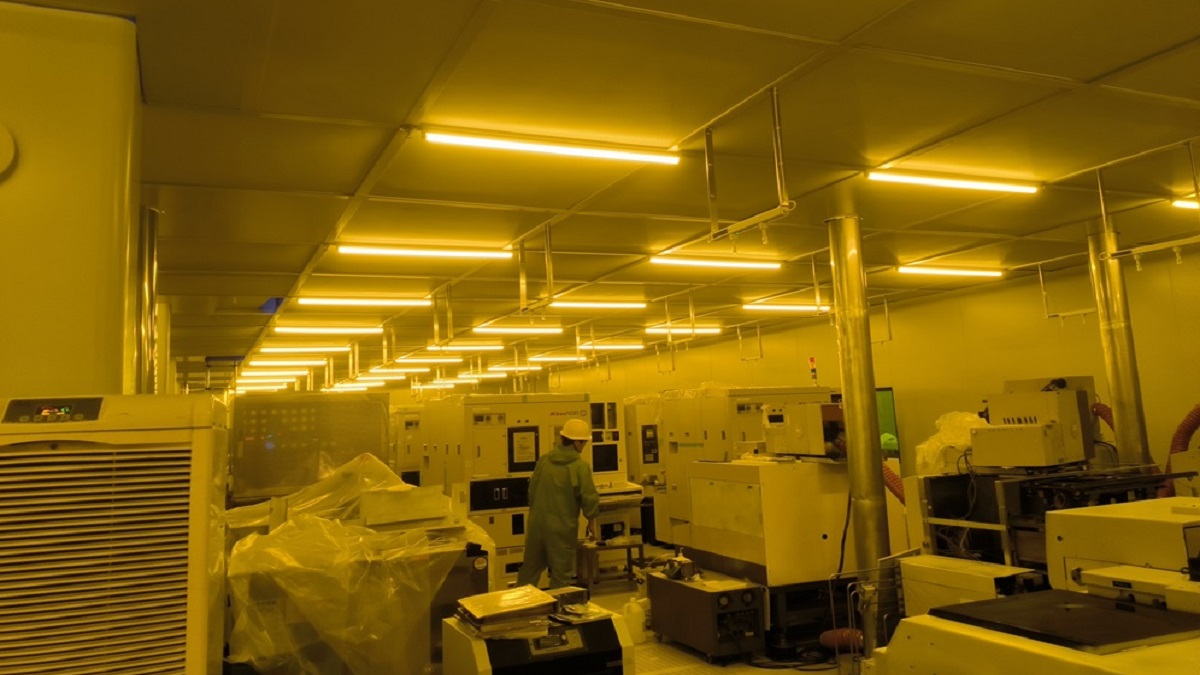
If you work in a cleanroom or a high-precision lab, you know that dust is the enemy. But did you know that most dust isn't just falling; it's being "pulled" in by static? This is called Electrostatic Attraction (ESA). A charged product surface acts like a magnet for airborne contaminants. I’ve seen production lines where products were being rejected simply because they were "dust magnets."Using a QEEPO ionizer fan effectively "disarms" the magnetic pull of your products. When the static is gone, dust particles are far less likely to stick, keeping your surfaces cleaner and your yield rates higher.
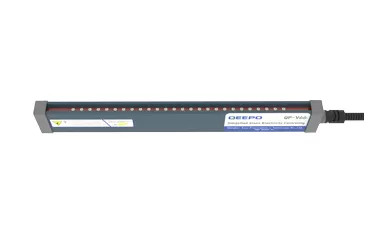
I often get asked, "Can’t I just use a passive ion bar?" While bars are great for fixed machinery, a fan offers two massive advantages: Distance and Decay Time. The built-in fan is what delivers the "medicine" (ions) to the "patient" (the product).
Decay Time: This is the speed at which static is neutralized. A high-quality fan ensures that ions reach the target before they recombine in the air.
Coverage Area: Whether it’s a small benchtop fan for a technician’s station or a three-fan overhead unit, the airflow ensures a wide "protection zone" that a passive device simply can’t match.
[Table: QEEPO Benchtop vs. Overhead Ionizer Performance]
Feature Benchtop Ionizer Fan Overhead Ionizer Fan Best For Individual workstations Large assembly areas Effective Range 300mm - 900mm 600mm - 1200mm Airflow Adjustability High (manual knob) High (digital/remote) Space Footprint Small footprint on desk Zero desk space (mounts above)
Not all ionizer fans are created equal. The most critical factor in a high-performing fan is Ion Balance. If a fan produces 60% positive ions and only 40% negative, it will actually create a charge on your product—the exact opposite of what we want. As a electrostatic control equipment manufacturer, we engineer our fans with automatic self-balancing technology. This ensures that, regardless of humidity or the age of the emitter pins, the output stays as close to 0V as possible. We also prioritize "low-noise" designs because I know from experience that a loud, buzzing fan is the last thing a technician wants to hear for an 8-hour shift.
The purpose of an ionizer fan is simple: to create a safe, neutral bubble where static cannot interfere with your production quality. Whether you are protecting a $500 processor or ensuring a medical device is free of dust, ionization is your most reliable line of defense. Still unsure which model fits your workbench? I’d be happy to walk you through the technical specs of our latest QEEPO series. Visit our product page or send me a message for a custom ESD audit. Let’s keep your production line static-free and your quality at its peak!

 +86-17717352246
  andy@qeepo.cn
 English
  日本語
日本語  한국어
한국어  français
  Español
  русский
  português
  العربية
  tiếng việt
  ไทย
ไทย  Polska