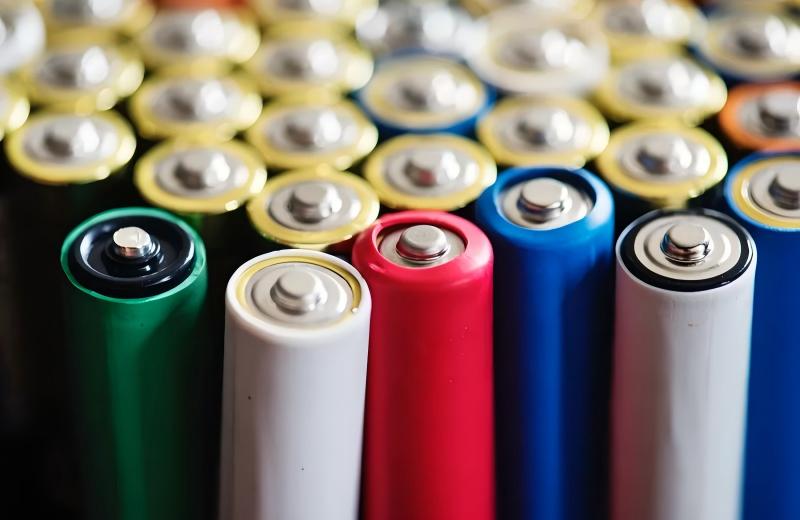
The global demand for high-capacity lithium-ion batteries is pushing manufacturers to accelerate production speeds while maintaining flawless quality standards. In this highly competitive landscape, battery cell manufacturers face a silent, invisible enemy on the factory floor: static electricity.
During the critical phases of electrode coating and slitting, materials move at high velocities, experience intense friction, and undergo continuous separation. These actions generate massive electrostatic charges. Without heavy-duty static control systems, these charges lead to catastrophic electrostatic discharge (ESD) events, unmanageable dust attraction, and severe safety hazards.
Managing these charges requires a deep understanding of where static develops and how industrial-grade static electricity eliminators work to safeguard the production line.
Lithium-ion battery manufacturing demands an environment with extreme precision and cleanliness. The two production stages most vulnerable to electrostatic issues are electrode coating and slitting.
During electrode coating, a slurry containing active materials is applied to a fast-moving metal foil substrate (aluminum foil for the cathode, copper foil for the anode). As the foil unrolls and passes through coating rollers at high speeds, friction generates massive surface charges.
The foil then enters a high-temperature drying oven to evaporate solvents like NMP (N-Methyl-2-pyrrolidone). If a static spark occurs near flammable solvent vapors, it can cause catastrophic factory fires. Furthermore, static charges attract airborne micro-particles, creating uneven slurry distribution, pinholes, and bubbles that lower battery capacity and lifecycle.
After drying, the wide electrode rolls are slit into narrower strips matching the required cell dimensions. The slitting process involves mechanical shear cutting blades slicing through the foil and dried active material coatings.
The physical separation of the slit materials creates sudden, intense static voltage spikes. This static field instantly grabs cutting dust and metallic slivers (slit slag). Trapped metallic particles on the electrode edges can eventually pierce the battery separator film during winding or stacking, causing internal short circuits and thermal runaway risks in finished battery packs.
To mitigate these risks, factories must integrate specialized static control systems at specific intervention points along the machine line.
| Process Stage | Specific Location | Static Risk Type | Ideal Technology Solution |
|---|---|---|---|
| Electrode Coating | Foil Unwinding Section | High-voltage charge generation from roll separation | Heavy-duty AC/DC ionizing bars |
| Electrode Coating | Slurry Application Zone | Particle attraction leading to pinholes and uneven coating | Close-range explosion-proof ionizing bars |
| Electrode Coating | Drying Oven Exit | Thermal friction charge accumulation during winding | High-temperature resistant static bars |
| Electrode Slitting | Rotary Slitting Blades | Cutting friction generating charge; attraction of metallic slit slag | Ultra-fast response static eliminator bars |
| Electrode Slitting | Strip Rewinding Section | Film friction and tight rewinding multiplying voltage | Continuous monitoring sensors and ionizers |
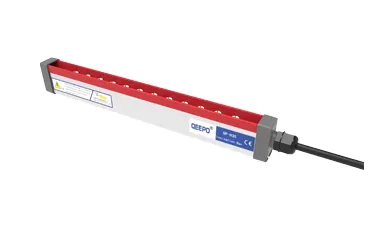
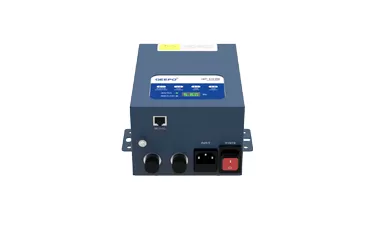
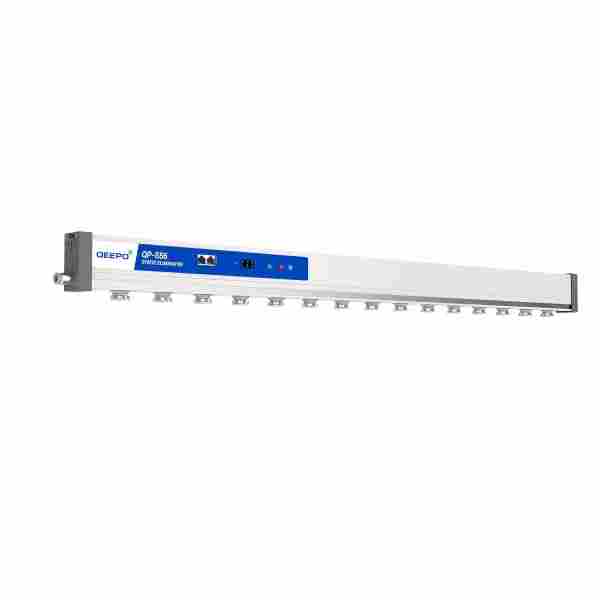
To successfully neutralize charges on rapid, continuous webs, modern production facilities rely on intelligent, networked static control systems. These setups combine real-time monitoring sensors with active ionization units to form an automated defense perimeter.
By measuring the voltage on the moving copper or aluminum substrate in real time, the control architecture automatically adjusts the ionization balance of active static electricity eliminators installed downstream. This ensures that the material arrives at the next process station with a neutral surface potential, eliminating both particle attraction and spark risks.
To see our full engineering specifications and design options, feel free to review our advanced ESD static control products.
Different stages of the electrode assembly line require different styles of ionization hardware to manage the unique mechanical constraints of the machinery.
For wide-web coating machines, standard passive copper tinsel or static brushes are insufficient. Manufacturers require active, long-range static electricity eliminators that emit a balanced cloud of positive and negative ions.
By utilizing alternating current (AC) or pulsed direct current (DC) technology, these bars project ions deep into the machine framework, neutralizing charges on the foil even when running at web speeds exceeding 80 meters per minute.
The cutting area of an electrode slitting machine is incredibly cramped, crowded with rotary blades, suction hoods, and guide rollers. Standard ionizing bars will not fit.
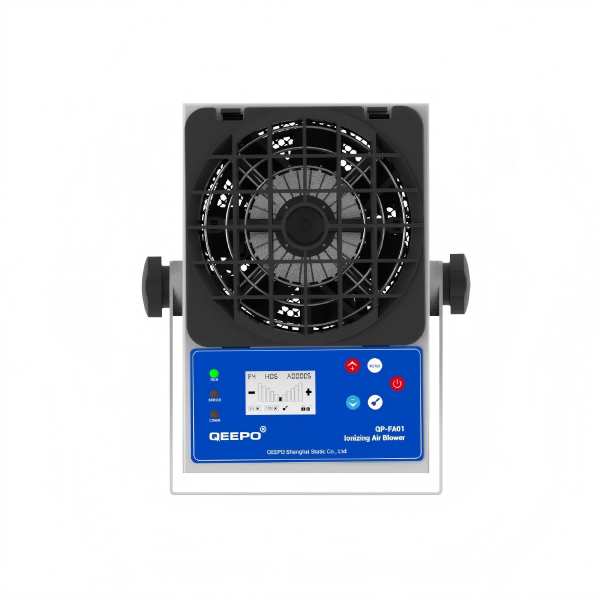
Advanced static control systems utilize micro-sized ionizing bars or specialized air-assisted nozzle networks. These compact units project ions directly onto the cutting edge the exact millisecond the blade shears the foil, neutralizing static instantly and allowing dust extraction hoods to vacuum away metallic debris cleanly.
Investing in robust static protection is not just about avoiding rare factory disasters; it has a direct, measurable impact on daily manufacturing profitability and operational metrics.
Minimizing Scrap Rates: By eliminating particle contamination during slurry coating, factories prevent micro-shortages and cell self-discharge defects, significantly increasing first-pass yield (FPY).
Preventing Separator Punctures: Keeping the slitting blade zone free of static-attracted metal slag means electrode edges remain smooth and free of burrs or debris, safeguarding the ultra-thin separator film during cell stacking.
Meeting International Standards: Implementing certified static electricity eliminators helps production facilities comply with rigorous global quality and safety standards, including ANSI/ESD S20.20 and IEC 61340 guidelines.
Controlling static electricity in lithium-ion battery manufacturing is a cornerstone of product reliability, safety, and performance. From preventing dangerous solvent ignition during electrode coating to eliminating microscopic metallic debris attraction during high-speed slitting, the implementation of comprehensive static control systems is essential for high-yield battery plants. Utilizing precision-engineered static electricity eliminators ensures your automated machinery runs cleanly, safely, and efficiently.
At QEEPO, we specialize in developing advanced electrostatic mitigation hardware tailored for the global new energy and battery manufacturing sectors. Our intelligent ionization bars, sensors, and power systems integrate directly into complex automation equipment, ensuring continuous runtime and exceptional cell quality.
If you are looking to audit your battery line's ESD vulnerabilities or need a tailored equipment blueprint, please visit our Technical Support & Contact Page to collaborate with our engineering specialists today.
Slitting involves the high-speed mechanical cutting of multi-layered materials (foil plus active material coating) combined with the rapid physical separation of multiple narrow strips. This intense friction and immediate separation amplify the triboelectric effect, leading to sudden high-voltage static spikes.
No. The coating zone handles volatile solvents like NMP, creating a hazardous vapor environment. Static electricity eliminators installed in or near these drying zones must feature explosion-proof certifications and sealed protection circuits to prevent the equipment itself from creating an ignition spark.
Static fields attract tiny conductive particles to the electrode surface during production. If these particles end up inside the sealed cell, they cause microscopic localized short circuits. By eliminating static, you prevent particle contamination, reducing cell self-discharge rates and extending the overall battery lifecycle.
Because battery electrode coatings generate conductive black dust (carbon/graphite/lithium metal oxides), this residue can accumulate on the emitter pins of your ionizing equipment. For battery lines, weekly checking and cleaning of the emitter pins are highly recommended to ensure the system maintains maximum ionization efficiency.

 +86-17717352246
  andy@qeepo.cn
 English
  日本語
日本語  한국어
한국어  français
  Español
  русский
  português
  العربية
  tiếng việt
  ไทย
ไทย  Polska